Memory
What the agent remembers, where, for how long.
35 patterns in this book. · Updated
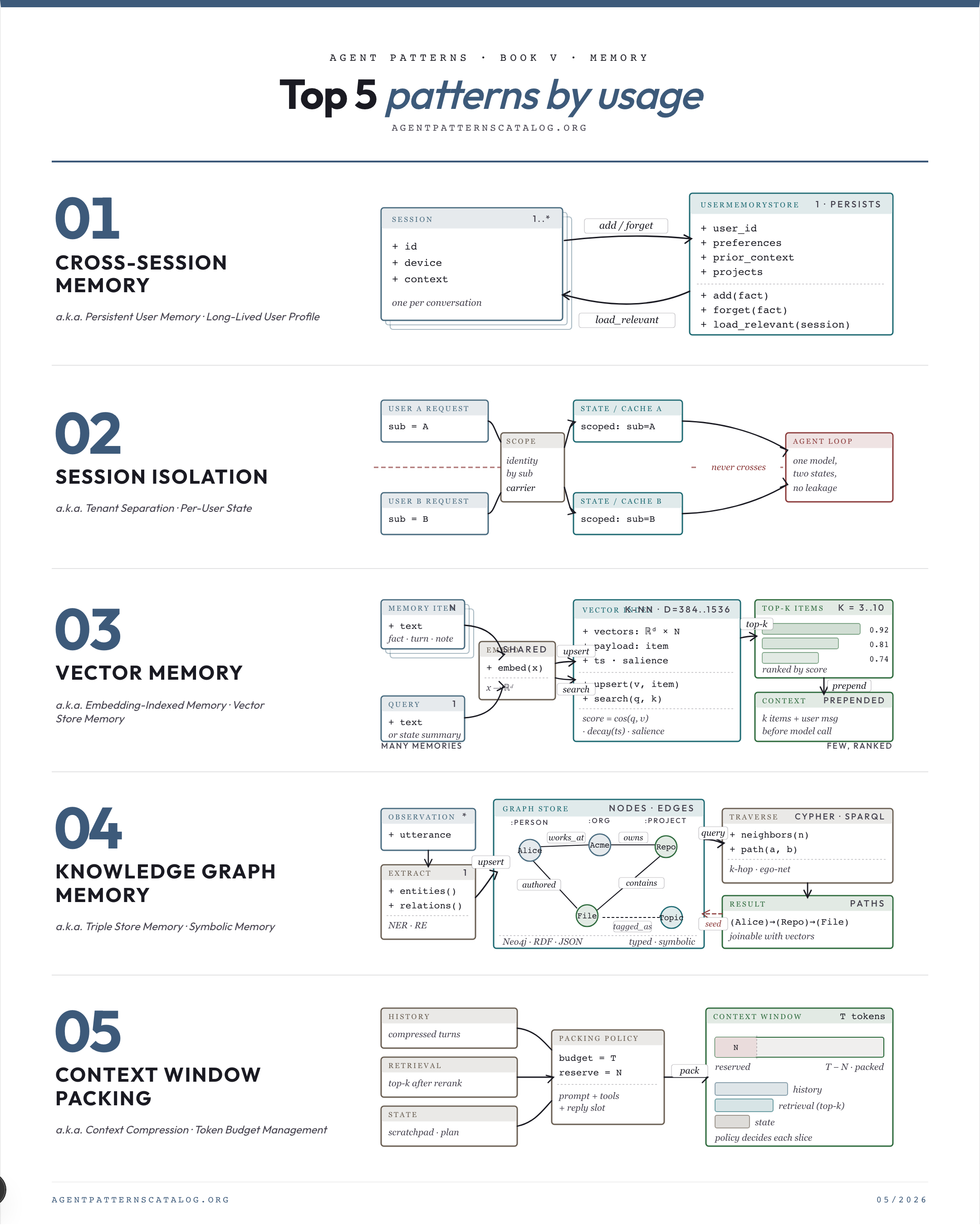
When to reach for each
01. Cross-Session Memory Persist user-specific facts, preferences, and prior context across all sessions, threads, and devices. Best for: Per-thread memory loses important user-specific facts between sessions and the assistant feels amnesic. Tradeoff: Privacy obligations. Watch for: Sessions are deliberately stateless for privacy or compliance reasons.
02. Session Isolation Keep one user's session state and memory unreachable from another user's agent. Best for: Multiple users share an agent backend and cross-user leaks are unacceptable. Tradeoff: Loss of cross-user cache benefits. Watch for: The agent serves a single user or fully trusted tenant.
03. Vector Memory Store memories as embeddings in a vector index and retrieve the most semantically similar items at query time. Best for: Long-running agents accumulate facts whose relevance is best judged by similarity. Tradeoff: Misses purely temporal queries ('what did I do yesterday?'). Watch for: Memory is small and a typed key-value store would serve better.
04. Knowledge Graph Memory Persist agent memory as entities and relations in a structured graph so symbolic queries (path, neighbour, type) become possible. Best for: The agent must answer relational queries (path, neighbour, type) over remembered entities. Tradeoff: Extraction quality bounds graph quality. Watch for: Memory is unstructured text where vector search is sufficient.
05. Context Window Packing Choose what fits in the context window each turn given a fixed token budget. Best for: Naive concatenation overflows the context window for realistic inputs. Tradeoff: Complexity of the packing logic. Watch for: Inputs are small and always fit comfortably in the window.
All patterns in this book
Cross-Session Memory
×23Persist user-specific facts, preferences, and prior context across all sessions, threads, and devices.
Session Isolation
×18Keep one user's session state and memory unreachable from another user's agent.
Vector Memory
×7Store memories as embeddings in a vector index and retrieve the most semantically similar items at query time.
Knowledge Graph Memory
×6Persist agent memory as entities and relations in a structured graph so symbolic queries (path, neighbour, type) become possible.
Context Window Packing
×5Choose what fits in the context window each turn given a fixed token budget.
Five-Tier Memory Cascade
×5Stage agent memory across sensory, working, short-term, episodic, and long-term tiers with explicit promotion and decay between them.
MemGPT-Style Paging
×4Treat the LLM context window as RAM and external storage as disk, with the model issuing tool calls to page memory in and out.
Episodic Summaries
×3Compress past episodes into summaries that preserve gist while shedding token cost.
Short-Term Thread Memory
×3Carry the relevant slice of conversation context across turns within a session.
Append-Only Thought Stream
×3Make the agent's thought log append-only so the agent cannot rewrite its own history.
Episodic Memory
×2Record past events as time-stamped first-person experiences the agent can recall later, separately from extracted facts (semantic) and learned how-to (procedural).
Filesystem as Context
×2Use the filesystem as the agent's externalized working memory, writing plans, notes, and large tool outputs to files, dropping them out of the live window, and re-reading on demand.
Reasoning Trace Carry-Forward
×2For reasoning models that emit a separate reasoning trace, preserve that trace in context across the same logical task episode (across tool-call/result turns) but drop it at user-turn boundaries.
Semantic Memory
×2Maintain a dedicated store of what the agent holds to be true about the user and the world, separate from event records (episodic) and learned how-to (procedural).
World-Model Graph Memory
×2Memory store structured as a typed entity-relation graph used as the agent's authoritative world model for planning — not only for retrieval.
Adaptive Memory Decay
×1Give each long-term memory item a retention score that decays over time through a function modulated by relevance, access frequency, and recency, so unreinforced items fade or fuse while items that a…
Agentic Memory
×1Expose memory management as first-class tool actions (ADD, UPDATE, DELETE, RETRIEVE, SUMMARY, FILTER) the LLM chooses at every step, trained end-to-end so short-term and long-term memory live under o…
Context Compaction
×1When the context window nears its limit, replace the older conversation span with a model-written digest that preserves decisions, commitments, and active constraints while discarding noise, so the a…
Procedural Memory
×1Maintain a third agent memory type alongside episodic (past events) and semantic (facts): procedural memory captures *learned how-to* — reusable skills, workflows, and self-rewritten system instructi…
Salience Attention Mechanism
×1Score every candidate memory item with a weighted salience function so each tick attends to a small, relevant top-k subset rather than re-reading all memory.
Co-Located Memory Surfacing
×1Surface relevant persistent memories proactively when the human mentions a concrete entity the agent has prior knowledge of, so the human does not bear the burden of remembering to ask.
Hippocampal Rehearsal
×1Lift archived memory items back into short-term tiers when something re-attends to them.
Now-Anchoring
×1Ground the agent's reasoning in the current absolute time without requiring tool calls, so every reply is implicitly time-aware.
Self-Corpus Vocabulary
×1Mine a small bounded vocabulary from the agent's own writing and cache it as the conceptual axis for scoring new thoughts, so relevance reflects the agent's actual frame rather than a generic embeddi…
Sleep-Time Compute
×1During idle or downtime, run the model offline against the user's standing context to pre-compute dense summaries and likely future answers, so test-time latency and cost drop when the user actually…
Information Chunking for Agent Memory
Structure inputs into digestible topical segments (chunks) before feeding to short-term memory rather than throwing the full input at the model; reduces overload and increases accuracy (~40% improvem…
Memory-Type Storage Specialization
Use different storage technologies optimized per memory type — fast in-memory stores (Redis-class) for episodic, vector databases (Pinecone/Weaviate) for semantic, relational or workflow engines for…
Scratchpad
Give the agent a writable scratch space for intermediate notes that informs later turns but does not pollute the response.
Context Window Dumb-Zone Cap
Hold context-window utilization below a working threshold (~40%) to keep the model out of the 'dumb zone' where it begins ignoring earlier instructions and hallucinating.
Execution-State Ledger
Maintain an execution state outside the model that records what the run has observed, changed and attempted, and consult it before each step so stale observations are refused and still-valid results…
Three Layers of Agentic AI Memory
Architect agent memory as three integrated concentric layers — Short-Term Memory (outer), Long-Term Memory (middle), Feedback Loops (core) — operating together as a unit rather than as separable opti…
Unstructured Human Capture Layer
Keep a human-authored raw dump layer that the agent may read but never edit, and confine all structuring to a separate derived layer, so half-formed human thought survives as durable context.
Context Folding
Let the agent branch into a temporary sub-context for a subtask and fold it back into a short summary on completion, so a long-horizon task stays within a small active window.
Landmark Attention
Long-context attention mechanism placing sparse landmark tokens across very long inputs so the model jumps directly to relevant sections via landmark lookup rather than scanning linearly.
Test-Time Memorization (Titans)
Memory module that learns at inference time by incorporating recent inputs into its parameters during the session rather than relying solely on pre-trained weights.