Multi-Agent
Two or more minds in coordination.
50 patterns in this book. · Updated
When to reach for each
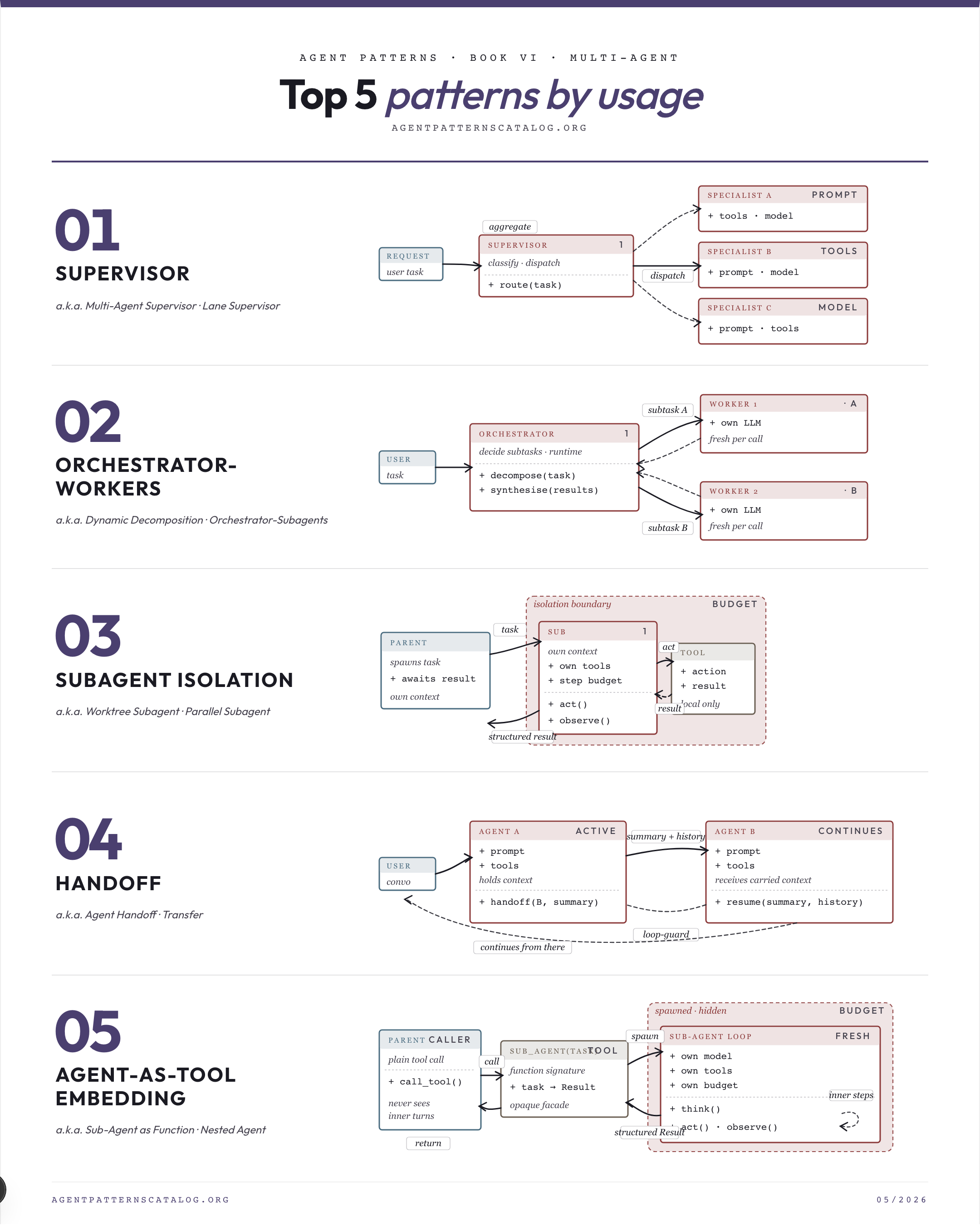
01. Supervisor Place a coordinating agent above a set of specialised agents and route work to them. Best for: Different request types want their own loop, prompt, tools, and possibly model. Tradeoff: Multi-agent before simpler patterns are running is decoration. Watch for: A single agent already handles the workload without confusion.
02. Orchestrator-Workers An orchestrator dynamically breaks a task into subtasks at runtime and delegates each to a worker LLM, then synthesises results. Best for: The shape of decomposition depends on the input and cannot be planned statically. Tradeoff: Orchestrator failure is unrecoverable without retry logic. Watch for: Static decomposition (Plan-and-Execute, Prompt Chaining) already fits the task.
03. Subagent Isolation Run subagents in isolated workspaces so their writes do not collide and parallelism is safe. Best for: A bounded sub-task has its own tool palette, prompt, or model. Tradeoff: Setup latency. Watch for: The parent must observe the sub's intermediate state for debugging.
04. Handoff Transfer the active conversation from one agent to another, carrying context across the switch. Best for: Mid-conversation routing must transfer context to a more appropriate specialist. Tradeoff: Context summary fidelity bounds quality. Watch for: A single agent can handle the conversation without rerouting.
05. Inter-Agent Communication Define a protocol for agents to exchange tasks, capabilities, and results across process or vendor boundaries. Best for: Multiple agents must exchange tasks, capabilities, or results across process or vendor boundaries. Tradeoff: Protocol overhead. Watch for: All agents run in one process and direct function calls suffice.
All patterns in this book
Supervisor
×41Place a coordinating agent above a set of specialised agents and route work to them.
Orchestrator-Workers
×32An orchestrator dynamically breaks a task into subtasks at runtime and delegates each to a worker LLM, then synthesises results.
Subagent Isolation
×26Run subagents in isolated workspaces so their writes do not collide and parallelism is safe.
Handoff
×11Transfer the active conversation from one agent to another, carrying context across the switch.
Inter-Agent Communication
×10Define a protocol for agents to exchange tasks, capabilities, and results across process or vendor boundaries.
Agent-as-Tool Embedding
×8Wrap a sub-agent (with its own loop, prompt, and tool palette) behind a single function-shaped tool signature, so the parent agent calls it like any other tool and never sees the sub-agent's internal…
Hierarchical Agents
×7Organise agents in a tree where higher-level agents decompose tasks for lower-level agents, recursively.
Role Assignment
×7Assign each agent a named role (researcher, writer, critic, planner) with a role-specific prompt, tool palette, and acceptance criteria.
CAMEL Role-Playing
×6Have two agents role-play a user-assistant interaction to autonomously complete a task neither could solve alone.
Blackboard
×5Give multiple agents a shared, queryable workspace they can read from and write to as they collaborate.
Performative Message
×4Inter-agent messages are typed by communicative intent (request, inform, propose, accept, refuse, query) rather than by free-form prose, so receivers can dispatch on act type.
Actor-Model Agents
×4Implement each agent as an independent actor with its own mailbox, processing asynchronous messages one at a time and never sharing mutable state with peers.
Conversational Multi-Agent
×3Have agents converse turn by turn until a completion criterion fires; agent roles drive the conversation forward.
Topic-Based Routing
×3Route inter-agent messages through named topics that agents subscribe to, instead of having senders address each other by id.
Debate
×3Have multiple agents argue different positions on a question and converge through structured exchange.
Contract Net Protocol
×2Classical bid-based multi-agent task allocation: a manager broadcasts a task announcement, contractors submit bids, and the manager awards the contract to the best bid.
Stigmergic Coordination
×2Agents coordinate indirectly by leaving and reading marks in a shared environment (files, queues, scratchpads, world model) so that one agent's trace stimulates another's next action, with no direct…
Parallel Fan-Out / Gather
×2Multiple independent agents execute in parallel on a partitioned task; a dedicated aggregator agent reconciles their results into a single output.
Group-Chat Manager
×1Place a dedicated manager between the participants of a multi-agent group chat that decides which participant speaks next on each turn.
Lead Researcher
×1A lead agent writes a research plan and dispatches parallel sub-agents that fan out for breadth-first information gathering, then merges results.
Vickrey Auction Allocation
×1Allocate a task to the lowest sealed bidder but pay them the second-lowest bid, making truthful cost reporting a dominant strategy.
Agent Capability Manifest
×1Let each agent publish a standardized self-description — identity, skills, endpoint, and auth needs — at a well-known location, so others discover it and bind by capability at runtime instead of thro…
Chat Chain
×1Decompose a long, multi-disciplinary task into ordered phases; within each phase, run a paired-role chat between two agents until the phase artefact is signed off; pass the artefact to the next phase.
Communicative Dehallucination
×1When an instructed agent would have to invent missing context to comply, have it reverse roles and ask the instructor for the missing detail before answering.
Cross-Domain Enterprise Agent Network
×1Decompose enterprise agency into domain-specialised agents (finance, supply chain, HR, service), each grounded in its own system of record, and route artefacts between them through a standardised int…
Decentralized Swarm Handoff
×1Agents in a swarm decide handoffs to peers based on a shared protocol with no central coordinator; specifically about agent-initiated handoff protocols, not topology.
Heterogeneous-Model Council with Synthesis Judge
×1Three or more role-specialized personas run on different model architectures in parallel; a synthesis judge — given only their structured JSON, not the original input — produces the final verdict.
Inner Committee
×1Run one model under several distinct personas (executor, critic, planner) within a single agent loop.
Magentic-One Generalist Multi-Agent
×1Use Microsoft's generalist multi-agent architecture: a single Orchestrator agent dispatches to four specialist sub-agents (WebSurfer, FileSurfer, Coder, ComputerTerminal) for solving open-ended compl…
One Tool, One Agent
×1Design agent systems as a team of narrow single-purpose agents, each owning one tool or one capability, rather than a single super-agent that handles every tool — the agent analogue of microservices…
Progressive Delegation
×1Stage the human-to-agent handoff over time: the agent starts producing drafts a human always reviews; its autonomy expands action-by-action as measured trust accrues.
Scatter-Gather Plus Saga
×1Distribute tasks across worker agents and aggregate results while maintaining distributed-transaction semantics via compensating actions on partial failure.
Signed Agent Card
×1Cryptographically sign an agent's published capability card so a consuming agent can verify it was issued by the claimed domain before binding to or delegating to it, closing the spoofing gap in agen…
SOP-Encoded Multi-Agent Workflow
×1Encode a human Standard Operating Procedure (roles, ordered phases, standardised hand-off artefacts) into a multi-agent pipeline so that agents communicate through structured documents rather than fr…
Voting-Based Cooperation
×1Finalise a decision across multiple agents by collecting and tallying their votes on candidate options, so the joint output reflects collective rather than single-agent judgement.
Coalition Formation
×1Agents form temporary subgroups around a task because the coalition can achieve more value than the sum of its members acting alone, with explicit rules for who joins and how payoff or credit is shar…
Decentralized Agent Network
×1Agents publish signed DID+JSON-LD identity records so any peer can discover and verify them without a central registry — the agent equivalent of the open web.
Dynamic Expert Recruitment
×1Generate the agent team — role descriptions and instances — at run time based on the specific task, then adjust team composition between iterations based on evaluation feedback.
Dynamic Topology Routing
×1Form and dissolve the connections between agents at runtime by matching the task to candidate collaborators, instead of committing the multi-agent system to a fixed chain, star, or mesh up front.
Joint Commitment Team
×1A team of agents adopts a shared goal plus the meta-commitment that each member will notify the others as soon as it believes the goal is achieved, impossible, or no longer relevant.
Personality Variant Overlay
×1Let one agent speak in several named voices that overlay the base identity rather than replacing it, so the agent can shift register without losing identity continuity or splitting into separate pers…
Swarm
×1Run many peer agents that interact directly without a central supervisor, achieving emergent coordination.
Actuation-Scope-Registered Control Loops
Have every long-lived automated loop declare, in a registry all loops share, the resources it may actuate and the indicator it optimises, so overlapping actuation scope is detectable before any loop…
Co-Tenant Interference Profiling
Before admitting a new autonomous controller to a fleet acting on one shared physical substrate, profile it in a sandbox against every incumbent, measure pairwise outcome degradation, and gate admiss…
Epistemic Fault-Domain Quorum
Credit a multi-agent quorum only with the resilience its distinct upstream roots justify, admitting the coalition when the number of independent root faults needed to compromise it clears a declared…
Pipeline Triad Pattern
Staff each pipeline stage with a triad — Creator generates an artifact, Critic finds flaws, Arbiter makes a binding PASS/FAIL/PARTIAL decision — with four explicit human gates between stages.
Talker-Reasoner
Split an interactive agent into a fast Talker for conversational responses and a slow Reasoner for deliberative planning and tool use, so the conversational loop never blocks on reasoning.
Cellular-Automata Agents
A swarm where each agent applies simple local rules to its immediate neighborhood; macro behavior emerges without a central orchestrator and without global information access.
Control-Loop-Mapped Agent Chain
Give each existing feedback loop in a plant's control chain its own operator agent carrying that loop's control-theoretic context, and resolve their competing proposals with the chain's own determini…
RL-Trained Conductor Orchestrator
Train a small meta-model with reinforcement learning to dispatch sub-tasks across a pool of frontier LLM workers, learning the communication topology end-to-end and allowing the conductor to recursiv…