Tool Use & Environment
How the agent reaches outside itself.
51 patterns in this book. · Updated
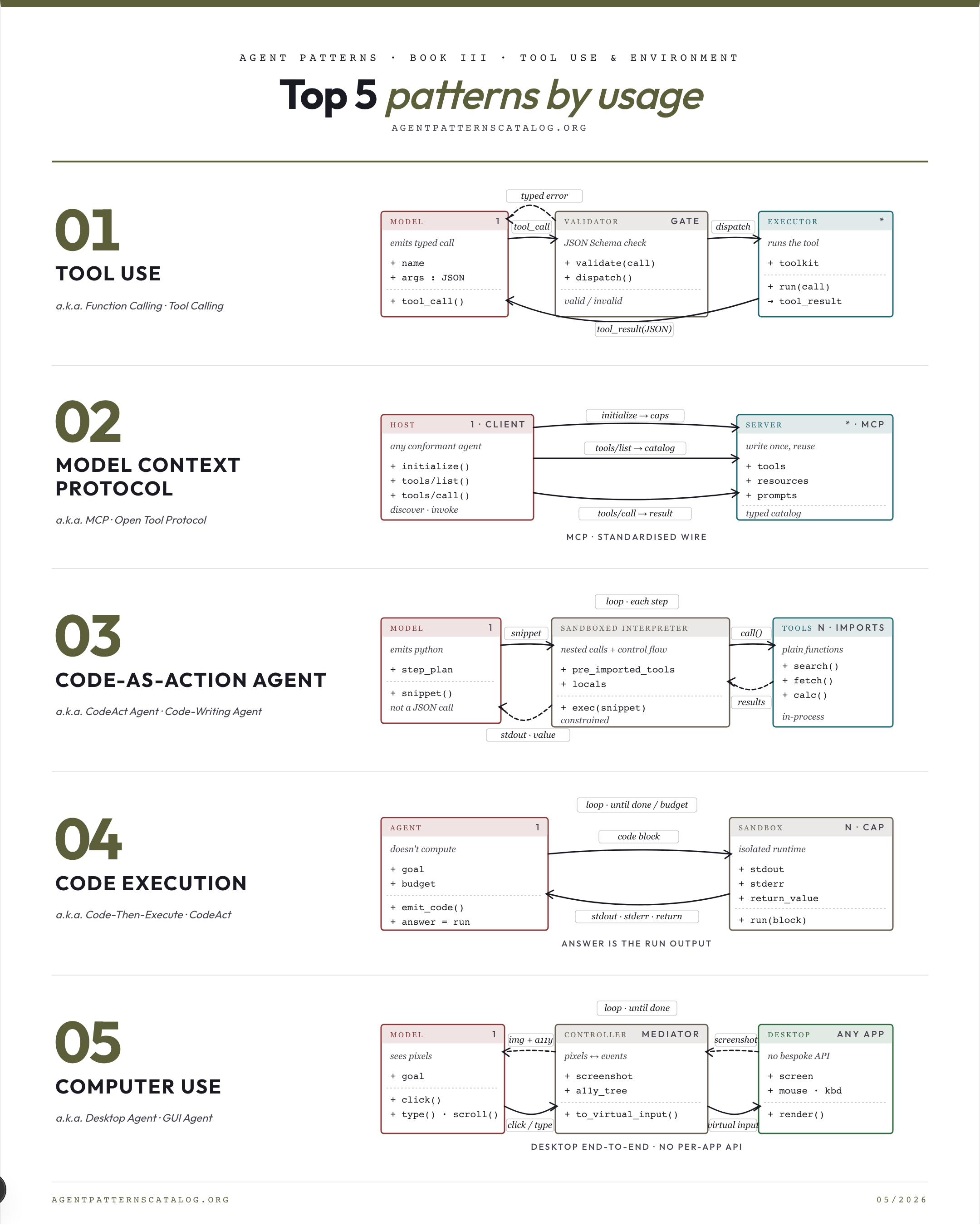
When to reach for each
01. Tool Use Let the LLM produce typed calls against an external toolkit instead of producing free-form text the surrounding system has to parse. Best for: The model must affect external state or query authoritative systems. Tradeoff: Tool palette design becomes the bottleneck; bad tools propagate to every call site. Watch for: The deliverable is free prose; structuring it as a tool call is overhead.
02. Model Context Protocol Standardise how agents discover and call tools so that a tool written once is usable by any conformant agent. Best for: Tool palettes need to be portable across multiple host applications. Tradeoff: Adds a process boundary; latency and operational surface increase. Watch for: Single host, single language, no portability requirement; native function calls are simpler.
03. Code Execution Let the model emit code, run it in a sandbox, and treat the run as the answer instead of trusting the model to compute in its head. Best for: The task involves calculation, parsing, or transformations that LLMs hallucinate. Tradeoff: Sandbox security is its own engineering problem. Watch for: The task is pure language with no computation that benefits from running code.
04. Code-as-Action Agent Have the agent emit a code snippet as its action each step, executed in a constrained interpreter, instead of emitting JSON tool calls; tool composition becomes function nesting and control flow inside the snippet. Best for: Tool composition is natural in code (filter, map, conditional chains) and clumsy as JSON tool calls. Tradeoff: Sandbox correctness is load-bearing; weak sandbox means arbitrary code execution. Watch for: The deployment cannot host or trust a sandboxed interpreter.
05. Computer Use Let the model drive a desktop end-to-end via screenshots plus virtual mouse/keyboard tool calls instead of bespoke per-app APIs. Best for: The target software has no clean API and the agent must drive a real desktop visually. Tradeoff: Slow and brittle on dynamic UIs. Watch for: A clean API exists and is faster, cheaper, and more reliable than visual control.
All patterns in this book
Tool Use
×136Let the LLM produce typed calls against an external toolkit instead of producing free-form text the surrounding system has to parse.
Model Context Protocol
×66Standardise how agents discover and call tools so that a tool written once is usable by any conformant agent.
Code Execution
×34Let the model emit code, run it in a sandbox, and treat the run as the answer instead of trusting the model to compute in its head.
Code-as-Action Agent
×32Have the agent emit a code snippet as its action each step, executed in a constrained interpreter, instead of emitting JSON tool calls; tool composition becomes function nesting and control flow insi…
Computer Use
×24Let the model drive a desktop end-to-end via screenshots plus virtual mouse/keyboard tool calls instead of bespoke per-app APIs.
Browser Agent
×21Expose websites to the agent through a structured DOM/accessibility tree plus a small action vocabulary, sitting between raw HTML and pixel-level Computer Use.
Sandbox Isolation
×20Run agent-emitted code or actions in a contained environment with restricted filesystem, network, and process privileges.
Agent-Computer Interface
×20Design the tool surface for an LLM agent specifically, with affordances different from human-facing CLIs.
Multilingual Voice Agent Stack
×17Compose a voice agent as a tightly co-located pipeline of speech-to-text, language-aware LLM reasoning, and text-to-speech, where one vendor owns all three so language and dialect propagate cleanly a…
Agent Skills
×12Package author-time procedures (markdown + optional resources) the agent loads on demand for specific task types.
Skill Library
×8Let the agent grow its own toolkit by writing reusable skills that subsequent runs can call.
Prompt Caching
×5Order prompts so the unchanging prefix can be cached by the provider, cutting per-call cost and latency.
Async Tool Handle
×5Have a slow tool return a job handle immediately and expose a separate poll tool for the result, so the agent loop never blocks past a tool-call timeout.
MCP Bidirectional Bridge
×5Run a framework as both MCP client (consuming external MCP servers as tools) and MCP server (publishing its own agents, tools, and workflows back over MCP) so capabilities flow both directions across…
Tool Loadout
×4Select a small task-relevant subset of available tools per request rather than exposing the full registry to the model.
Agent-Initiated Payment
×4Give an agent a bounded wallet so it can settle a payment mid-request to unlock a resource — answering a payment-required challenge with a verifiable proof — instead of routing every purchase through…
Shadow Workspace
×4Mirror the workspace into an isolated, version-controlled shadow where the agent makes and reverts edits, surfacing diffs for review and promoting only accepted changes to the real tree.
Tool Result Caching
×3Cache the result of expensive deterministic tool calls keyed by their arguments so repeat calls within a session return immediately.
Canonical-Entity Grounding
×3Require the agent to resolve every business identifier it uses — SKU, account, supplier, customer — through an authoritative lookup against the system of record, rather than emitting the identifier f…
Dual-System GUI Agent
×3Split a GUI agent into a decision model that plans and recovers from errors and a grounding model that observes pixels and emits the precise action; route each subproblem to the better-suited model.
Tool Discovery
×3Let the agent discover available tools at runtime rather than hardcoding the tool list at agent build time.
Tool/Agent Registry
×3Maintain a single queryable catalogue of both available tools and available agents, with metadata (capability, cost, latency, quality) the agent can use to pick the right one for a task.
Agent-Readable Commerce Surface
×2Expose a service to agent buyers through a machine-readable product feed and an agent-initiated checkout API rather than a human click funnel, so an agent can discover, compare, and buy against a goa…
Direct API Wrapper
×2Expose an existing API as MCP tools by mapping each operation one-to-one to a tool, so a stable API becomes agent-callable with minimal wrapper logic.
MCP-as-Code-API
×2Materialize MCP servers as a directory of typed code wrappers so the agent writes code that imports them and large tool outputs flow between calls inside the sandbox without ever entering the model's…
Mobile UI Agent
×2Drive a smartphone end-to-end through a small, touch-native action vocabulary (tap, long-press, swipe, type, back, home) over screenshots, as a distinct interaction surface from desktop Computer Use…
Semantic-Layer Query Guardrail
×2Route natural-language data questions through a curated semantic layer so the model selects and parameterises vetted metrics and dimensions instead of free-authoring raw SQL against production data.
MCP Server-Side Sampling
×2Let an MCP server, mid-tool-call, send a prompt back to the host through createMessage and use the host's model so the server does language work without holding its own model or key.
Agent Adapter
×1An interface layer connecting an agent's tool-calling protocol to heterogeneous external tools, normalizing their schemas into one the agent expects.
Augmented LLM
×1Build the foundational agent block as an LLM augmented with retrieval, tools, and memory that the model actively chooses to use, rather than a bare-model call.
Crawler Dispatcher
×1Route each incoming URL to a domain-specific crawler through a central dispatcher mapping URL patterns to registered crawler classes.
Translation Layer
×1Insert a typed boundary between the agent's clean domain model and a messy or legacy external API.
Composite Service
×1Expose one MCP tool that orchestrates several underlying API calls into a single higher-level operation, so the agent invokes a task-level capability instead of chaining many low-level endpoints.
Forkable Agent Sandbox
×1Turn the agent's whole execution environment, including filesystem, memory and running processes, into a versioned object that can be snapshotted, forked into isolated branches, rolled back and selec…
Foveated Perception Escalation
×1Treat observation fidelity as a budget the agent allocates: perceive the whole surface coarsely, let the reasoning name the region that decides the answer, then re-observe only that region at full re…
Full-Desktop Computer Use
×1Give the agent a complete containerized OS desktop with native apps, a persistent filesystem, and desktop credential stores, so it can finish multi-application workflows a browser-only surface cannot.
Tool Search Lazy Loading
×1Defer loading tool schemas into the context window until a search step shows they are needed.
Tool-Result Eviction
×1Once a tool's raw output has been consumed, replace it in the live context window with a short marker of what was done, reclaiming tokens without losing that the call happened.
Affordance Grounding Before Action
×1Have a vision-language model ground each candidate action against the current scene and predict its affordance, so that actions the environment cannot physically support are discarded before any reac…
App Exploration Phase
×1Before deploying an agent against an opaque app, have it explore (or watch a human demonstrate) the app, generating a per-element documentation knowledge base; at deployment, retrieve element docs to…
Large Action Models (LAMs)
×1Use a model class specifically trained for action execution (tool calls, UI navigation, workflow steps) rather than text generation, when the workload is dominated by reliably completing actions in r…
Tool Transition Fusion
×1Mine tool-call telemetry for high-probability X-then-Y transitions and fuse those pairs into a single composite tool, shrinking the planner's step count.
Hierarchical Tool Selection
Organise tools into a tree of categories so the agent first picks a branch and then a specific tool within it.
Machine-Checkable Tool Contract
Express every constraint a tool places on its caller in the machine-readable schema rather than the prose description, and return failures as typed fields the caller can branch on.
Mirrored Tool Environment
Replace the live external tool during agent training and benchmarking with a fine-tuned model that emits responses in that tool's shape, so runs stay cheap, reproducible and controllable in difficult…
Policy-Localizer-Validator
Split a GUI agent into three specialist models — a Policy that plans, a Localizer that grounds elements to pixels, and a Validator that judges completion — so each role uses the smallest sufficient m…
Solver-Ready Formulation Handoff
Have the agent emit a declarative optimisation model — decision variables, objective, hard constraints — in a solver-agnostic representation, and let an exact solver produce the decision with its fea…
On-Demand Tool Synthesis
When no available tool fits a subtask, have the agent write, validate, and register a new tool on the spot, separating the tool-creating role from the tool-using role.
Synthetic Filesystem Overlay
Project heterogeneous enterprise data sources into a single Unix-like tree exposed through filesystem primitives so the agent reuses path semantics it already knows instead of learning a bespoke API…
WebAssembly Skill Runtime
Package each agent skill as a WebAssembly module with a capability manifest, and run it inside a Wasm runtime that enforces those capabilities, so untrusted skills cannot weaken the host's sandbox.
Toolformer
Train the model to learn when and how to call tools through self-supervised data, without human annotation.